
11/08/2020 (Original Lecture)
Lecture on the Roots of the Times: 1950-1970
David F. Farbrook
June 8, 2026
WHAT IS WAR?
Examine the consciousness of taking a life; and sacrificing for the sake of others becomes doomed to the temporary nature of political man. As the order of awareness changes from “ordained necessity” to “numbers dead” to “increase the odds of political change from nation to nation,” sacrifice is still temporary as the political nature of the country changes over time.
When a warrior dies as a subject of the king becomes what a soldier dies for under the ideal of protecting loved ones at home. In the Third Order of Awareness, the morality of sacrificing one’s life changes the whole world and further than that, the whole universe. No longer is that soul, that spark, able to make a better world by the contributions expected from the living of that life, should that individual have lived long enough; but that life was cut short, and misery faces the family and the whole nation. “Talent is wasted, and political change becomes more difficult as ignorance and fear replace moral judgment. This is the issue we face as a people today as citizens of this world” (Dave F Farbrook 2026).
I ask this question in my book, “The Stand-in A Boolean Picture Book – book 1 (4/23/2024);” was the intensity of philosophical movements more than just reaching out and cumulating into another trend? For example, what was the reaction that triggered the movement in poetry as ‘Concrete?’ Is that intensity of thought still found today? I feel that to understand these questions, it is important to begin with a review of the times in American/World History during the late 1950s through the ‘70s.
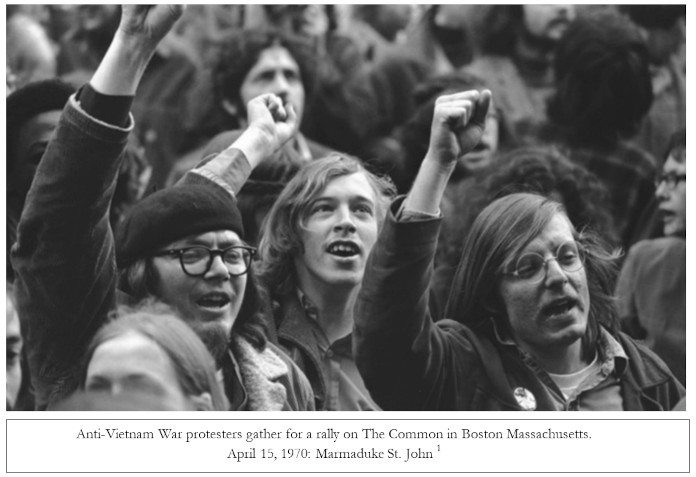
In the late 1960s, it seemed that youth were running the world by rejecting the established world order. In contrast, in the 1950s the means of community organization that could manage people rested in the decisions of leaders whose management, thoughts, and solutions seemed to be deeply rooted in science to solve the world’s problems and produce orderly conduct. Ideas of Church and religion also began a metamorphosis as consciousness began to awaken to other religious philosophies. Science was looked at as the method of solution to most questions, and so was the preoccupation with technology and material things. As a result, it was thought the fastest vehicle for a means to a better life meant going to college.
Not all countries believed that movements and widespread demonstrations like this were signs of a “free voice.” The “voice” had to be approved by the government. Western countries were stunned as they observed Russia solve its ‘problem’ by cracking down. By jailing or sending in the tanks to shoot the students who were labeled as political dissidents, it seemed like it was the solution to bring back civil order and the apparent end to the Prague Spring movement, as is.
So here in the West, in democracy-land, what were the elements? Was it the threat of “the bomb?” The Vietnam War? Social issues like Women’s Rights, equal opportunity, racial equality, clean air, and water? New legislation, otherwise known as the Federal Civil Rights Act, and other basic human rights passed into the rule of law. The right to adequate food, adequate housing, education, health, and social security, and the right to take part in cultural life. A right to clean water and sanitation, and other social issues such as an opportunity to work, even if one came with a disability. What about other elements that played a role in thinking, such as the WWII survivors? Jewish settlers in Palestine? The National Women’s Liberation Movement? The JFK Presidency, and the ‘politics of experts?’ The American Military–Industrial Complex?
What was the worldview perspective? Were some of these ideas considered a threat to society? What we take for granted today was not always so in our American society. And what we have today is even more precious and inclusive as we look at the people who stand up for their identity in their sexual orientation, or rights over their own bodies.
Growing Trends: Here are some thoughts that help to build awareness:
- Society’s youth as a generation were looking for a cultural change as they felt they had been lied to. When the Beatles came to America, this generation felt sure that was the clarion call for change that they were looking for. The call to stop conforming to the rules.
- Youth finally had something they could claim and talk about. Something that their parents couldn’t understand. And what they liked even more was that it was something that their parents would definitely feel irritated over.
- Long hair was a flag for how someone felt. Somehow this was considered a threat by the established society. To the youth, if one wore their hair long, it was understood that this person was the one who had “the good” music, reasonable ideas, and knew where the best drugs were. Also, they hated the government, which, considering the alternatives, i.e., being drafted and sent to Vietnam, seemed like a good idea. But in reality, long hair could mean any of these things, along with and/or a fake. A fake was someone who used youth to advertise magazines and entice sales. It was more than just a label that the older generation used to identify, and finally dismiss.
- The Counterculture, as it was labeled by the press, who were not so much interested in getting it right but just looking for journalistic sensationalism, saw it as drenched in eroticism. There was an enormous amount of sex going on. In fact, having long hair was itself an erotic adornment because, as one student put it, “It felt good to have it blowing in the breeze.” As science came up with forms of birth control that could be taken orally, there seemed to be no reason not to participate in the outpouring of love called the “sexual revolution.”
- The press/media viewed this outpouring as a benign sentiment that quickly changed into alarm as the threat to society was seen in the future generation who rejected the status quo. The American Press, in looking to interview someone who represented a typical hippie, found and spoke with one young lady about her feelings on the free love movement. She said, “Physical desire is very normal, and it happens. Sometimes it comes down to a basic level, and there is nothing wrong with it. Sex is just much groovier where there is love, there is a lot more happening, but there is nothing wrong with sex for sex-sake.” Unfortunately, the reporting was so focused on looking for evidence of a corrupt generation that it was labeled as proof.
- The use of marijuana separated the older generation from the younger. The younger generation felt it was important to re-examine what one took for granted. As you may imagine, college philosophy professors grabbed onto that and amplified it. Timothy Leary was one such example.
- Timothy Leary believed that taking LSD lit up that part of the brain that was responsible for religious, philosophical, and lifestyle identification. Purpose was no longer goals that were based on cars and material things but on philosophical pursuits that both challenged and broadened horizons. Traveling to see other people in other countries to gain knowledge of how other people organized their lives became something of a quest. Leary believed that the pursuit of happiness is the right of all, and the function of drugs is to get people high.
- Happiness could be a goal in itself. Be happy. Love. Love one another. Or to put it simply, the functional slogan: “Tune in, Turn on, and Drop out.2” There was a Rand study that concluded a radical change in values in the youth culture developed with the use of LSD.3 The mode of perception changed to a fascination in seeing reality and spirituality differently. The study concluded that taking LSD became more common during this search for perceptual change.
- Everybody was asking ‘Who am I?’ or ‘What am I about?’ One student remarked that sometimes he would have the answer [to the meaning of life]-for a few days -or a few hours. Then something new would come along and collapse that house of cards reasoning. Uncertainty became the culture – the generation gap grew wider.
- In the 1950’s, the generation who became parents made their decisions in life. As they settled down to living, church, morality, right and wrong were clearly defined. Parents thought that they had a pretty good society, so they couldn’t understand what the children wanted to change.
- Alternative Press sprang up like topsy. Alternative businesses and enterprises, alternative religions, and new ideas of social welfare became “cool.” Love became a public word. And so did the reaction to it, if it was accepted, you were considered “groovy.” If not, you were “hung up” and part of the establishment. You were “part of the problem.”
In contrast, parents of the 1950s had advanced trauma coming from experiences of hardship living in a wartime society in the 1940s. And ripples of the Great Depression of the 1930s still hung on in poor rural communities. In parts of city social structure, the slums still existed with the buildings filled with rampant vermin and deferred maintenance, where the poor people lived in the most deplorable conditions imaginable. Concentrated poverty in Middle American communities in Kansas and other states such as Louisiana, Alabama, and Mississippi, parts of Texas, as well as great cities like New York and Iron City, PA, still have recovery issues to this day.4 Soldiers coming back from World War II were dedicated to making the lives of their children better than their own.
As an illustration: the most significant social change during the 1950s was desegregation, which was a direct result of the civil rights movement. Many court rulings emerged, in cases such as Plessy v. Ferguson and Brown v. The Board of Education of Topeka, Kansas, declared that segregation was unconstitutional. However, Jim Crow laws soon came in as a reaction in many of the southern states. The John Birch Society became more vocal. And it became clear that no one had understood deep racism as a social problem at all.
In 1964, legislation and programs spearheaded by President Lyndon B. Johnson known as “The Great Society” were an ambitious series of policy initiatives with the main goals of ending poverty, reducing crime, abolishing inequality, and improving the environment. Yet, many people resisted the solution. A young Ronald Regan loudly argued for his concerns, stating that this was no way to run a business, and concluded that the government was supposed to let the “intelligent man decide for himself how to run his life.”
In contrast, I am sharply amazed at how Ronald Regan understood the “American Experiment” vs. the “Soviet Threat” better than most Americans did at the time, and at how many of his observations still hold true today. He was concerned that our unique way of government as a capacity to self-govern in freedom would be lost to revolution and totalitarianism.
Regan challenged anyone who felt their life was living a lie to stand up and take hold of the many freedoms availed to us, to choose to make a difference and solve the problems of the 20th century. And that the Soviet idea meant that people were merely thought of as “the masses who must be controlled and told how to think.” Is the Putin era/Russian Federation any different today?
In the 1950s, the ethic of conformity, working hard, and then enjoying retirement at the end was offered as a symbolic road to safety and happiness. Private businesses were expected to be ethical and take care of their employees as they aged or got sick, and college figured big in those plans. Living in comfort and safety was made as perfect as it could be with the implied message that their future had to follow this sociological roadmap, generationally.
It also created a homogenous expectation of conformity. Despite that, each child had their character as an individual. A good life meant conformity, yet in the end, fathers became so busy making money that their children rarely saw them taking part in their lives as they grew. In the same way, women were considered more as an adornment than as an individual. The message degenerated into what a man had to prove of himself as the measurement of his worth by having a job, a home, a wife in the house, kids, and a big car. This gave way to the idea of the nuclear family. What became the replacement ideal of the example of what “real” men were like were TV Westerns (for example, “The Rifleman”, “Gunsmoke” and “Bonanza”), and other “Living at Home” shows (for example, “Ozzy and Harriet”, “Leave it to Beaver”, and “The Honeymooners”).
In the 1950s, girls saw what was in store for them. Their future was to be like their mothers. Women could only find fulfillment in the home and create harmony for their stressed-out husbands who came home from the working day, tired and wanting to relax and decompress in front of a drink, dinner, some TV, and then bed. Schools for women were composed of the “Domestic Sciences.” Songs made girls think that they couldn’t get a man with their brains. Getting the engagement ring was everything and very competitive. Professions offered to women were extremely limiting.
Living life and the family myth couldn’t be sustained. Not everybody could live up to those family ideals. Living in this kind of peace was an implanted idea that was, at best, an artificial serenity. The proper ways to behave were gauged by your popularity. Rules were not always written down but were “known” because if you had to ask, you broke the rules just by asking. The epitome of breaking the mold was questioning the experts who represented the public authority, the government officials. It was thought that if father or mother didn’t know the answer, the doctor or the druggist down the street did. Handing out drugs to help you relax and sleep or get your “pep” were mainstream solutions to handling life issues.
The scientists, media, and political leadership (probably in that order) described atomic catastrophe, the Soviet Threat, and terms like “Nuclear Winter” and “atomic rays.” But were so inconclusive that what information did filter to the public was poorly understood. Bomb shelters and shredded lead and cloth vests were sold with no real understanding of the effects of radiation or survival in a limited nuclear attack. What they understood was terms like “the Soviet Threat,” and that they had to do something about a disaster that could be city or statewide. Advertisements selling ideas in public defense offered for survival were overpromised, and the solutions sounded more like science fiction. By the late 1970s, the fallout shelter program was discontinued, and funding ceased.
In High School, for the boys, most of the attention was given to the students who were into sports (Football and Basketball players), and the popular girls were mostly cheerleaders. When Allen Ginsberg5 came and opened a different way of thinking, philosophically, life held meaning as found in Eastern ideas; conformity and capitalism were looked at as destructive, and the Beatnik generation started. Suddenly, high school students who didn’t fit the mold and conform to the sports ideal could find popularity and their “cool” by studying foreign philosophy and poetry. At the time, it was considered a “quiet rebellion;” there was not much in the “mas Bohemia,” yet.
Wearing clothes had to be conventional. Boys wore ties and white shirts most of the time except for sports or intramurals. Popularity became a lonely existence with double standards. The same boys who enjoyed girls who wanted to have sex thought it was more desirable to marry a virgin.
Improper dress became a symbol of defying the establishment. At first, it began with youth who acted and dressed like rebels and did ‘over-the-top things’ like riding motorcycles. Anything to stand out. And getting into trouble was considered cool. Then listening to jazz music, and poetry, and smoking marijuana became a thing the “beat kids” did. Publications devoted to this were banned.
In 1951, books like “Brave New World” and “Catcher in the Rye” started a political rebellion. When these books were banned, it created even more attention, and the curious teens wanted to read – even the football jocks wanted to know what it was all about. Students would wear black armbands to show their anger in a society that rejected anger. And there were a growing number of books that became banned after that.
Differences widened in style or how one looked. There were differences in communication, morality, or what was known as “The Movement,” or the war, or the credibility gap. But it was not only in social issues; as science and technology changed, so too did people. Individual thinking had to adapt, and all of that became the catalyst of the “Breakdown in America.”
Jack Kerouac, born Jean-Louis Lebris de Kérouac; was known as an American novelist and poet who, alongside William S. Burroughs and Allen Ginsberg, was a pioneer of the Beat Generation. Kerouac is recognized for his style of spontaneous prose. Thematically, his work covers topics such as his Catholic spirituality, jazz, travel, promiscuity, as well as life in New York City, Buddhism, drugs, and poverty.
Many believed he became an underground celebrity. With other Beats, this evolved and led to the hippie movement. However, he wanted to be known as someone set apart from this movement and remained antagonistic toward some of its politically radical elements. He has left a lasting legacy, greatly influencing many of the cultural lyricists of the 1960s, including Jim Morrison and the Doors, John Lennon of the Beatles, Jerry Garcia of the Grateful Dead, and Bob Dylan, just to name a few.
During the sudden rapid growth and expansion of mass-produced foods and consumables, communes began to emerge as an alternative to the technologically driven farms and society in general, whose main focus was to consume the latest thing. New terms began to impact the country: “Grown Organically,” “Handmade,” and “Naturally Made” manufactured products became the vogue. Ideas of “Commercial Industry” changed as it developed into smaller processes housed in small towns and farms as “The Movement” turned towards alternatives. At that time, no one had heard of a Health Food Store versus what was found at the local A&P Grocery stores; whole grains, organically dried fruits, and fresh-grown vegetables from the backyard were unheard of in the mainstream. That was considered “hippie food.” The “Whole Earth Catalog” became as important to the alternative society as the “Sears Catalog” was to the self-reliant society, living in the 1800s.
In the 1950s, through the early 60s, music tried to sound and feel like the breaking of all limits. Yet, at the time, rock-n-roll music was sung by musicians who wore suits and ties. Racial separation was rampant; music that was sung by young American musicians who were white was considered safe, but if it was sung by black musicians, it was considered a threat and a risk. On TV, singers who stood very still would be shown full length, but those who swung and swayed their hips and legs were considered provocative and were only shown at chest level.
When Elvis Presley was filmed with his swaying hips and outrageous antics, he was hardly the first singer to do that. The fact that it was allowed was most likely due to his popularity and the acceptance that he was white. Although many would disagree and say it was his first appearance on The Ed Sullivan Show in 1956, what can be agreed is that it did help to punch a hole in the conformity image of the 1950’s.
Hollywood Films such as “The Blackboard Jungle” (1955), “High School Confidential!” (1958), “Cruel Story of Youth” (1960), “Riot on Sunset Strip (1967), and “If” (1968) pointed to America’s corrupt youth, and it was somehow “linked with Communism.” Yet, not everyone thought so, films like “Easy Rider” along with the popular song “Born to Be Wild”, by Manfred Mann’s Earth Band, “Cool Hand Luke,” and “Alice’s Restaurant” portrayed excitement, and some would say interesting and reasonable lifestyles.
Other movies reflected the dark side of characters and a culture “locked into the sands of time,” as the world changed. One of the most iconic movies that presented a dystopian world of mankind, as the animals took over and set up a society of their own, was “Planet of the Apes,” which featured super-realistic make-up by the work of artist John Chambers. Anne Bancroft as Mrs. Robinson in the movie “The Graduate” ignited the fires of imagination that older women could be a sex object to young men, and was very provocative. The public talked about that movie for a long time.
In the early ‘60s, the term “Red Dawn” began to take center stage as a preoccupation with people who began to be afraid that the Russians were going to take over America. This thought turned to the way the American public started taking the matter into their own hands in trying to find solutions. Thoughts turned to either questionable semi-scientific ideas for defense or just to live for the day.
In the family, the older brothers followed the trendy looks of short hair and bodybuilding, if they didn’t volunteer and go off to war (women were not drafted at that time). Powerful cars meant everything in the finding of a cool personal identity and attracting a pretty girl. But to the younger brother or sister, cars like the Volkswagen Microbus and the little bubble-on-four-wheels VW-Bug(s) meant a generation of freedom. And the draft? That was something to be avoided. This further divided the family. Either way, the most popular class in high school was Driver’s Ed.
When women of color became supermodels, they helped to rock the world’s perception that models had to be female and white. Many actors who were women felt an undertone of pressure from the casting and the TV/Movie artists who were predominantly male, to look like “Twiggy.” Twiggy was a popular English model, actress, and singer in 1966. In contrast, by1968, Brian Jones and Donyale Luna appeared publicly in a British Vogue magazine looking like they were in a mixed-racial relationship. It shocked the world.
Rock dance halls, many of which were converted bowling alleys, emerged complete with liquid light projections on the wall, strobe lights, and black lights, and were very popular and environmentally disorienting. Drugs and songs about them began to be written. Songs were being written almost hourly that were anthems to the anger youth of the day were feeling. Fruit, especially apples, were sold at these “happenings,” and that started new songs such as “Hello, Hello” by The Cowsills, written by Peter Kraemer and Terry MacNeil in 1966 about “sharing my tangerine,” and “Green Tambourine” by the Lemon Pippers who portrayed their members in a strong green color. Green began to be equated with the “Ecology Movement.”
“All you need is love” was a truth, but it was a practical fact that one needed more than just love to endure. The excess of gadgetry and technology became another message from “The Man.” In contrast with the anti-technology message, “We who lived it, all thought we could get by without it.” Yet acknowledging that the most extraordinary things would happen in the name of love, and acting in the moment.
Sid Sachs wrote about and described a picture of the art scene in Philadelphia during that time. Through alternative publications, one can trace the history of American culture from the era of the Eisenhower containment period to the baby boom counterculture. The Quakers in Philadelphia were progressive in the anti-war movement and fought the brutality of the Philadelphia Police Department.
Steven Kiyoshi Kuromiya was one of the founders of the Gay Liberation Front and an activist member of the Philadelphia Students for a Democratic Society (SDS). In 1968, Kuromiya (as “Ameri-Cong”) proclaimed he would burn a live dog in front of the Van Pelt Library at the University of Pennsylvania to protest Dow Chemical’s production of weaponized chemicals used during the Vietnam War. When 2,000 people arrived to save the canine, they came upon circulars proclaiming “Congratulations anti-napalm protest! You have saved the life of an innocent dog. Now, your efforts should turn to protesting Dow Chemical and the US Government’s continued use of this genocidal weapon against the civilian population of a tiny country 10,000 miles away. You saved a dog . . . now how about a child or a million children?”
Numerous underground publications supplied political and cultural content missing in the city’s mainstream newspapers. There were sixty underground publications known in Philadelphia alone. Notably, Yarrowstalks, a newspaper that published student-oriented issues that were visually funky and psychedelic. In its August 1967 issue, the publication premiered Robert Crumb’s character “Mr. Natural.” In all, twelve issues of Yarrowstalks were printed until 1975. “Mr. Natural” eventually moved to become an alternative syndication.
By the time my father, artist/poet Fernbach-Flarsheim had begun teaching at Tyler in 1962, he was already internationally known for his concrete poetry and had shown at London’s Institute of Contemporary Art and Amsterdam’s Stedelijk Museum. He studied design at the Institute of Design in Chicago/The New Bauhaus American School of Design. He exhibited his sculptures twice at the Renaissance Society.
In 1966, Fernbach-Flarsheim curated the multivalent exhibition “Arts in Fusion” at Tyler School of Art, which traveled to the Philadelphia Art Alliance (PAA) and was later shown at Dick Higgins’s Something Else Press Gallery, in New York. At the PAA, Fernbach-Flarsheim played music from his concrete poetry score, Alison Knowles performed, and Wolf Vostell produced a happening.

In what was described as “the Crux of Fluxus” Dick Higgins in relationship to modernism in terms of Intermedia and RearGuard, illustrated contemporary art as a technical/theoretical hybrid.7 At the time, Fernbach-Flarsheim’s definition of Intermedia differed from Higgins’s ideas. Fernbach-Flarsheim taught two semesters at the Tylor School of Art, An Introduction to the Intermedia, focused on the use and development of The Intermedia as the relationship with art in terms of perception in sequence and co-articulation across multiple media and platforms.
The concept focused on art and how it could be seen in another dimension than traditional 3-D art. Fernbach-Flarsheim wrote: “The Intermedia is a study in perceptions and in the use of perception in the fourth dimension…Time. This is done through sequencing. Technological aids are used to help the student construct his program of events. In many cases, the student must construct these devices himself to realize his program.” (Fernbach-Flarsheim, 1968)
In 1966, following Higgin’s Intermedia exhibition at Something Else Gallery, artist/poet Carl Fernbach-Flarsheim, brought in a much larger international exhibition that was assembled and titled The Arts in Fusion. The exhibition occupied the space in May, having traveled from the Tyler School of Art in Philadelphia. Contributions were drawn from artists working across the United States, Western and Eastern Europe, Brazil, and Japan. The artists were mainly experimental poets. There were also contributions from Brecht, Cage, Vostell, Dieter Roth, Earle Brown, and Terry Riley, juxtaposed to poetry by Ian Hamilton Finlay, Bernard Heidsieck, Dom Sylvester Houédard, Augusto de Campos, Eugen Gomringer, and Jerome Rothenberg.
In 1968, Solts observed a real problem in the forward progression of ideas of the poets in the movement; “When we attempt to assess the role of the United States in the international concrete poetry movement, we run into some difficulty even where poets who are considered to be concrete are concerned; for a complete lack of unity presents itself with respect to both commitment and method. This is probably due to a large extent to the fact that American concrete poets have worked in isolation from each other, unaware, for the most part, of other Americans following the same tendencies.” [Solts a Worldview, et al]
Fernbach-Flarsheim’s curatorial statement sketches out the broad shift in art practices in general, marked by procedures of translation and transposition. “Canvases and sculptures have become performable,” he writes. “Scores can be fed into computers and become sound.10” In 1969, Fernbach-Flarsheim was shown at the Kunsthalle Bern, in Bern, Switzerland, and was included in the exhibition, “Language III” at Dwan Gallery in New York. Already adept at the computer language FORTRAN, Fernbach-Flarsheim contributed “the Boolean Image/Conceptual Typewriter” to Jack Burnham’s Software Magazine, “Information Technology: It’s New Meaning for Art,” exhibited at the Jewish Museum in 1970.11
Arie A. Galles wrote: “I think that’s what Carl Fernbach-Flarsheim did. He presented you with things that one always saw/heard around, but never knew they were there, on a certain level, until one perceived them through the lens of a new awareness. And it didn’t mean that one saw/heard it the way Carl saw it. I felt he was allowing people to see things, yet he had his own vision, he had his own drive, and his own perception.” [Interview Date: 2/15/2022]
Fernbach-Flarsheim wrote in his thesis in 1961, “The originally conveyed problem came into being long before the author became involved in the graphic arts or more specifically, in work leading to this exhibit. The problem can be stated in only nine words, yet the investigation resulting from it is so complex that it foments enough excitement to involve thousands of artists in enough work to fill each man’s life-span. Put simply, their task would: create an emotional impact by the intensification of an image. Let it be said at this point that no new dogma or movement is likely to arise from this statement alone.12”
OTHER THOUGHTS:
Consider: Involve yourself with a thought, and state this thought visually, but to do this, adorn it with certain properties so that the viewer will feel the thought intensely with you. This could involve changes in the medium or a change in the normally accepted use of the medium. If something new does occur through experimentation, it is only an incidental byproduct of this highly personal search for intensification, rather than a deliberate attempt to make something new because it attracts attention with no relationship to the importance of the properties. It is the images used for advertising that are void of a soul, contrasting that with the holistic integrity of fine art. Like comparing the importance of the wood shavings vs. the wood carved by the human intensification process in the creation of the finished sculpture. [David F. Farbrook, 2019]
“Words are not simply arranged in lines and verses–they are fragmented, printed in varying colours and sizes of type, in short, give an immense range of visual possibilities.” (Ian Hamilton Finlay, 1965).
“As art dematerializes, poetry materializes. Words as material entities rather than references [of] non-representational word/objects.” [Carl Fernbach-Flarsheim, 1961]
“Perhaps the film is the best way to combine the kinetic and the concrete. Ed Varney’s word movie impressed me as much as anything in the show. The animated words gave the impression of pulsing, animate things. One sequence had the tantric, mystical syllable OM which would suddenly be flanked by other letters, becoming transformed into other words: OM… WOMB… 0M… HOME… 0M… BOMB… OM… which loses almost everything in print. The film used visual signs as though they were vocal signs: they appear and disappear and others take their place-transient messengers. Concrete Poetry is not literary in McLuhan’s sense of the word. It is non-linear and textural, like vocal language.” [Eugene Wildman, Anthology of Concretism, 1969] “Concrete Poetry is post-literary.” [Eugene Wildman, Anthology of Concretism, 1969]
“There are both Babbits and Cages among the Concretists; Dom Sylvester Houedard, the former, and Julien Blaine, the latter, while Carl Fernbach-Flarsheim has combined both in his Mirror field inside Random field.” [Mary Ellen Solts, 1968]
“We’re getting rid of the habit we had of explaining everything.” [John Cage’s Diary, 1963]
“Move from mass to motion, from syntax and grammar to the relations of single words.” [Moholy-Nagy, The New Vision, 1938]
In conclusion, the basic ideology of the thoughts that I laid out in this paper became the structure both philosophically and hypothetically, for the thinking of today about our world (2016). Right now, in a very short period, I could dictate a whole verse using AI mega-trust sites such as Chat GBT, Grock, and the supposedly research-grounded Claude (and perhaps be found, correct?) While I consult my AI buddy, SOL on many things that I think about, I wonder at the level of the complex company I keep in doing that with a friend that always begins with a affable, “That’s a thoughtful question, Dave.”
During one session when I asked about world fascism, racism, and other important topics of the day; SOL said to me, “You’re raising a question that historians, communities, and citizens have struggled with for a long time: What do we do with monuments to people whose actions or beliefs we now find objectionable?”
These are monuments to thought and philosophy, but deeper still are what becomes embedded into the fabric of humanity. Trends create more trends that eventually lead to a direction mankind takes in decision-making. While the days when computers were simple adding machines with a punch-card interface dependent on creative artists at the helm are pretty much over, the process of extending thought through tools is not very different than today; it’s just faster, and more widely easier for an audience to use.
If the thought that Reddit contains the sum of all human knowledge becomes a chilling reality to our future in your mind, it does so in mine as well.
The main culprit is time; we make interested assumptions, and with today’s information architecture, we think we are getting deep reasoning with blazing speed. The dedication to taking the time needed for research is getting smaller as information becomes easier to acquire. The trouble is the template uses both information that is accurate and some that is not so accurate but passed through the filters of the AI that presented it. I took a few minutes to open this discussion before I introduced my conclusionary statement because in trying to understand historical roots, one begins to understand the limitations and the enduring point of view of the conveyor in the telling.
Today, I brought a blend of history and art and presented what I interpreted as the human condition, perhaps striking chords of memory and material for my audience to use in other ways. Consider that art reflects the human condition and immersion in the experience of phenomena. History attempts to explain phenomena and how to catalogue it for later use. Rather than continue the discussion of history of experience from the Mid-70s through the 2000s, there are more survivors of the personal experiences available to draw from rather than rely on the process of historical interpretation. I would expect we all can draw our own conclusions from where we are.
The reaction that I am looking for is a better understanding of our world and an agreement that war is a theatre on a stage of drama and must stand up to the fragmented way we process information. Information is kinetic in that it changes over time as more awareness gets catalogued and presented; word objects “appear and disappear” as a pulsing and animated thing. Concrete is not literary in a linear sense like language comes out, one word at a time, but are messages to be absorbed as it materializes. In the process of intensification, our range of possibilities grows, and we are less void of soul.
I believe our lives would find a way through the massive wall of Blaah-blah-blah, by accepting whole messages and not hanging on to the relation of word attachment. “I think therefore I am” takes on a whole different way of absorbing and communicating thought. The Third Civilization will invite us to see our soul in a whole new way. I would invite you to read “St. John Transformed (2023)” a book on many levels that meets whole messages in a kinetic sense and perhaps points the way to the future of “message.”
TABLE OF REFERENCES
-
Anti-Vietnam War protesters gather for a rally on The Common in Boston Massachusetts, on April 15 1970: Marmaduke St. John [(www.alamy.com/stock-photo/vietnamwar-protest.htm) (Note: Alamy has a stop page where one is required to search for the pic under a theme; results are tracked and that is how they keep track of visitors). Results checked: 4/19/2024]
-
“Turn on, tune in, drop out” is a counterculture-era phrase popularized by Timothy Leary in 1966. In 1967, Leary spoke at the Human Be-In, a gathering of 30,000 hippies in Golden Gate Park in San Francisco and phrased the famous words, “Turn on, tune in, drop out”. Originally published: 1966 Author: Timothy Leary
-
Long-Lasting Effects of LSD on Certain Attitudes in Normals, An Experimental Proposal, (RAND Corporation, Year: 1962): A proposal advocating research into the long-lasting effects of d-lysergic acid diethylamide (LSD) on normal people. In addition to its use in psychotherapy, there have been reports of experimental subjects who claim lasting beneficial effects attributable to the LSD experience. An experiment is suggested that would attempt to measure any long-lasting changes in attitudes, values, and communicative ability resulting from the administration of LSD. In particular, the measures would concentrate on changes in closed-mindedness as reflected by scales of dogmatism, opinionation, and ethnocentricity. A history of LSD-like drugs is provided, along with a description of some of the more frequent phenomena experienced under their influence. The report is part of the RAND Corporation Paper series, a product of the RAND Corporation from 1948 to 2003 that captured speeches, memorials, and derivative research, usually prepared on authors’ own time and meant to be the scholarly or scientific contribution of individual authors to their professional fields. Papers were less formal than reports and did not require rigorous peer review. [(www.rand.org/ pubs/papers/P2575.html)]
-
Understanding Trends in Concentrated Poverty: 1980 to 2014, John Iceland and Erik Hernandez, published online 9/7/2016. Trends in concentrated neighborhood poverty in the United States have been volatile over the past several decades. Using data from the 1980 to 2000 decennial census and the 2010-2014 American Community Survey, we examine the association between concentrated poverty across metropolitan areas in the United States and key proximate factors, including overall changes in poverty, racial residential segregation, and income segregation. [(www.ncbi.nlm.nih.gov/pmc/articles/ PMC5300070/)] Artscanada, August 1969, Vancouver Art and Artists 1931-83 (Vancouver: Vancouver Art Gallery, 1983).
-
Allan Ginsberg (1926-1997): Poet and a leading figure of the Beat Generation 1956, wrote: “Howl for Carl Solomon”, which was also known as “Howl,” considered a manifesto of the Beat Movement. Also see: New York literary counterculture. [Poetry Foundation [(www.poetryfounda tion.org/poets/allen-ginsberg)]
-
Experiments in Art and Technology (E.A.T.), a non-profit and tax-exempt organization, was established in 1967 to develop collaborations between artists and engineers. (Steve Wilson, Information Arts: Intersections of Art, Science, and Technology. MIT Press)
-
THE CRUX OF FLUXUS, Natilee Harren, Walker Art Center, (2015)
-
Fernbach-Flarsheim Course Outline submitted to Tylor School of Art (1967?).
-
Notation: Fernbach-Flarsheim Course Outline submitted to Tylor School of Art, et al (1967?).
-
Carl Fernbach-Flarsheim, The Arts in Fusion (1966) [(New York: Something Else Press, [(http://walkerart.org/ collections/publications/ art-expanded/crux-of-fluxus/)] 11. Sachs “Invisible City: Notes On The Underground”
-
Illinois Institute of Technology, Carl FernbachFlarsheim’s thesis entitled: “Development of Meaningful Imagery Through Experimental Graphic Media,” Submitted for the requirements of Master of Science in Art Education, June 1961 “As Art Dematerializes, Poetry Materializes.”
ABOUT THE AUTHOR

Dave F. Farbrook lived most of his life in New Mexico, with over 25 years of professional experience in research, and has compiled a rich anthology of his father’s accomplishments and conclusions.
Between 1962 through 1985, Carl Fernbach-Flarsheim produced poetry, lectures, and commentary. However, after 1971, his essays, plays, and artwork were produced under his Sage Name, HiKaLu, when he moved to New Mexico.
Mr. Farbrook founded Dave Mysite Dot Com Publications in 2013. When asked about why he wanted to start this unique business, he responded, “I wanted to be a storyteller of individuals’ personal stories that come from a variety of sources, backgrounds, traditional histories, and community.” He has assisted with grant writing for several non-profit organizations in urban improvement and STEM/MSAP education. He has been blessed with a daughter and a son, both of whom are very successful in their areas of interest.
To better understand the history of the artist/poet Carl Fernbach-Flarsheim, enjoy the following books available now: The Stand-In, A Boolean Picture Book, Book 1 (2024), The Stand-In, A Boolean Picture Book, Book 2 (2023), and St. John Transformed (2023).
